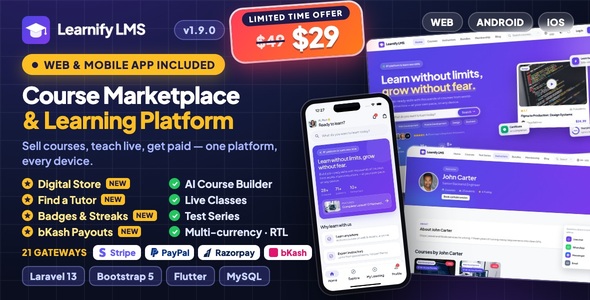
Today is the last day our price will be $44 from tomorrow.


Learnify LMS | Online Course Marketplace and Learning Platform With Flutter App
Learnify LMS is a complete online course marketplace and learning management
system — a public storefront where students discover and buy courses, a workspace where
instructors build and sell them, and an admin panel that runs the business behind both. Students learn
on the web or in the included Flutter app, and their progress follows them between the two.
From one Laravel 13 backend you get the course storefront, the student learning area, the
instructor workspace, the full admin back office and a Flutter app for Android and iOS.
Everything ships together in the main download package and talks to a single backend and database over a
documented REST API.
A course moves through one flow — created, submitted, approved, published, purchased, studied, completed,
certified — while the platform commission is split, instructor earnings accrue to a ledger, payouts are
requested and paid, and every transaction posts to double-entry accounts automatically. The platform
supports multi-language usability with RTL and LTR layouts across web and mobile.
Demo
Web
Storefront: lms.bugbuild.com
Admin panel ·
Instructor workspace ·
Student area
Demo logins (password for all: 12345678)
Admin: [email protected]
Instructor: [email protected]
Student: [email protected]
Android app
Download the demo APK
— the login screen has one-tap Student and Instructor demo accounts, so you can sign in without typing anything (demo site only; they never appear on your own install).
The same accounts are offered as one-tap chips on the demo login page. The demo resets every hour, so
please do not change the demo passwords.
What You Get
- Laravel Web Backend — course storefront (page-builder driven), student learning area with the lesson player, instructor workspace, and the full admin back office.
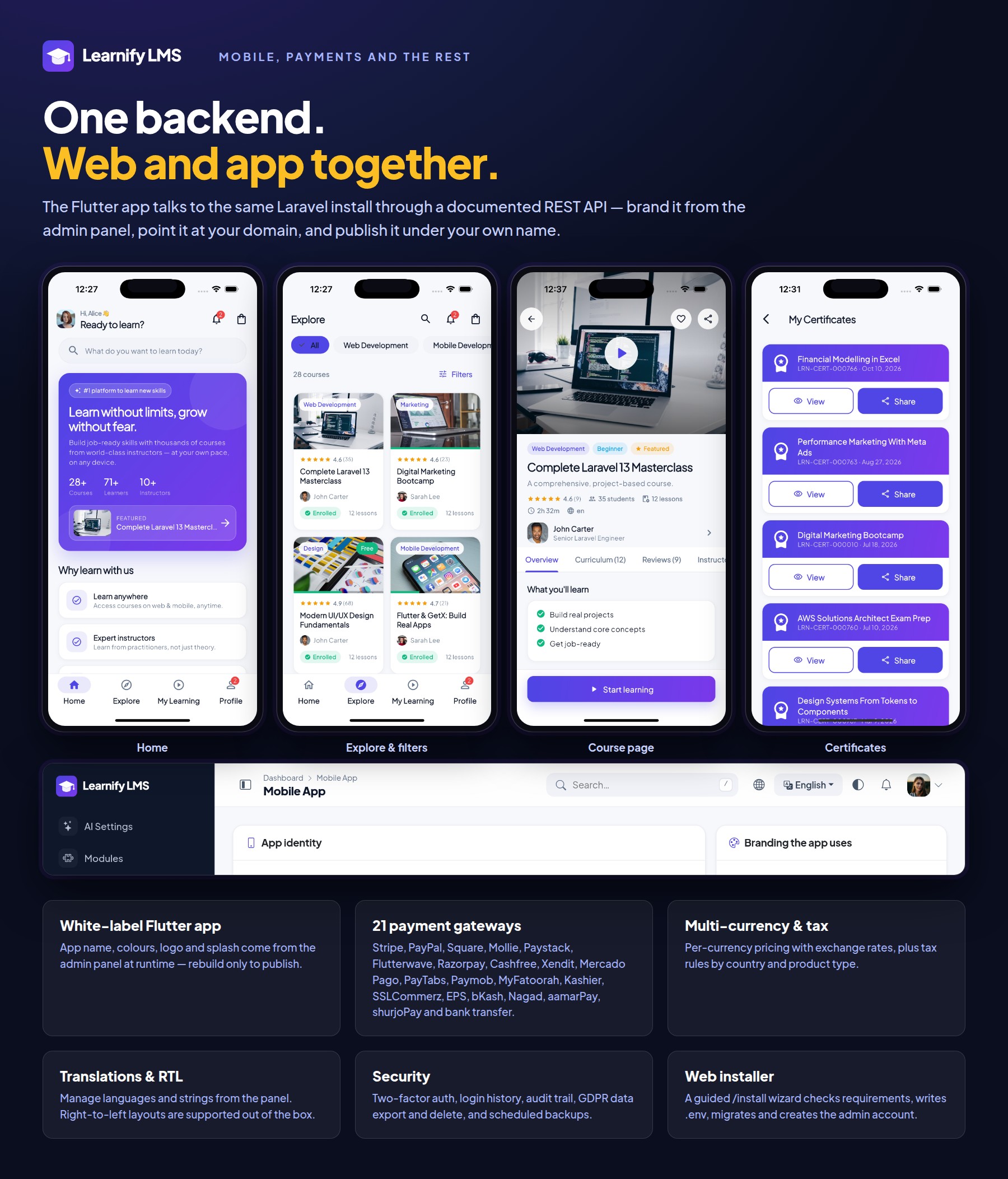
- Mobile App (Flutter) — one app for students and instructors: browse and buy courses, watch lessons with progress sync, take quizzes, download for offline, join live classes, collect certificates and badges; instructors get an earnings dashboard and assignment grading.
- Both platforms are included — one Flutter codebase with the Android and iOS projects in the package; nothing is sold separately or excluded.
- Full source code for the backend and the app, the database, and complete documentation — all inside the main
Main_Files.zip, as two folders: WebSourceCode (Laravel) and AppSourceCode (Flutter, Android and iOS).
- Web installer — a guided
/install wizard checks requirements, writes the environment file, runs the migrations and creates your admin account. No command line needed. Works on shared hosting: no symlink() needed, and an interrupted install simply resumes.
- No ionCube, no licence server, no phone-home. The code is plain, readable PHP and Dart. Nothing in the product checks a purchase code at runtime, so your site can never go down because a licensing server did.
- Four website templates — Aurora (modern gradient), Academy (classic institute), Editorial (minimal & typographic) and Nova (dark & techy). Preview any of them on your live site, then apply with one click; your sections, copy and brand colours carry over.
- 21 payment gateways — Stripe, PayPal, Square, Mollie, Paystack, Flutterwave, Razorpay, Cashfree, Xendit, Mercado Pago, PayTabs, Paymob, MyFatoorah, Kashier, SSLCommerz, EPS, bKash, Nagad, aamarPay, shurjoPay and manual bank transfer — each with sandbox mode, per-gateway fees and API refunds where the provider supports them.
- One-click updates — upload the release ZIP in the admin panel and it installs itself: backup, migrate, reseed roles/permissions and reference data, clear caches, safely re-runnable. No SSH needed; a manual/cPanel path with a one-command fallback is there too. Your custom head/CSS/body code lives in the database and survives every update.
Who It Is For
Course marketplaces that sign up many instructors and take a commission, individual creators and coaches
selling their own catalogue, training companies and academies running paid or internal programmes, and
schools or institutes that need fees, batches and guardians alongside their courses. It is a learning
platform, not a general webshop — nothing in the panel is retail noise you have to work around.
Important Note About Third-Party Service Costs
Any costs related to hosting, domains, server infrastructure, SMS gateway providers, email services,
push-notification (Firebase) services, video hosting or CDN providers, Apple/Google developer accounts
for publishing the app, or any other third-party service are not included in the item
price. Buyers must purchase and configure these separately based on their own requirements. You also
generate your own application key and configure your own credentials during setup.
Payment gateways — Stripe, PayPal, Square, Mollie, Paystack, Flutterwave, Razorpay, Cashfree,
Xendit, Mercado Pago, PayTabs, Paymob, MyFatoorah, Kashier, SSLCommerz, EPS, bKash, Nagad, aamarPay and shurjoPay are independent third-party services. You need your own merchant account with each one, and their
transaction fees, currency-conversion charges and account requirements are between you and the provider.
Stripe Connect is used for automatic instructor payouts and has its own onboarding and
country availability rules.
AI features — the optional course-outline generator, the AI tutor inside a course and the
grading assistant can call a large-language-model API (Anthropic Claude, or any OpenAI-compatible
endpoint). They are off by default, run only with an API key you add under Settings, and
are billed by the AI provider on your own account; no AI service is included with the item.
Documentation
Full installation, configuration and app build guides:
View Documentation
— the same files ship in the documentation folder inside the download.

Application Features
Course Marketplace & Storefront
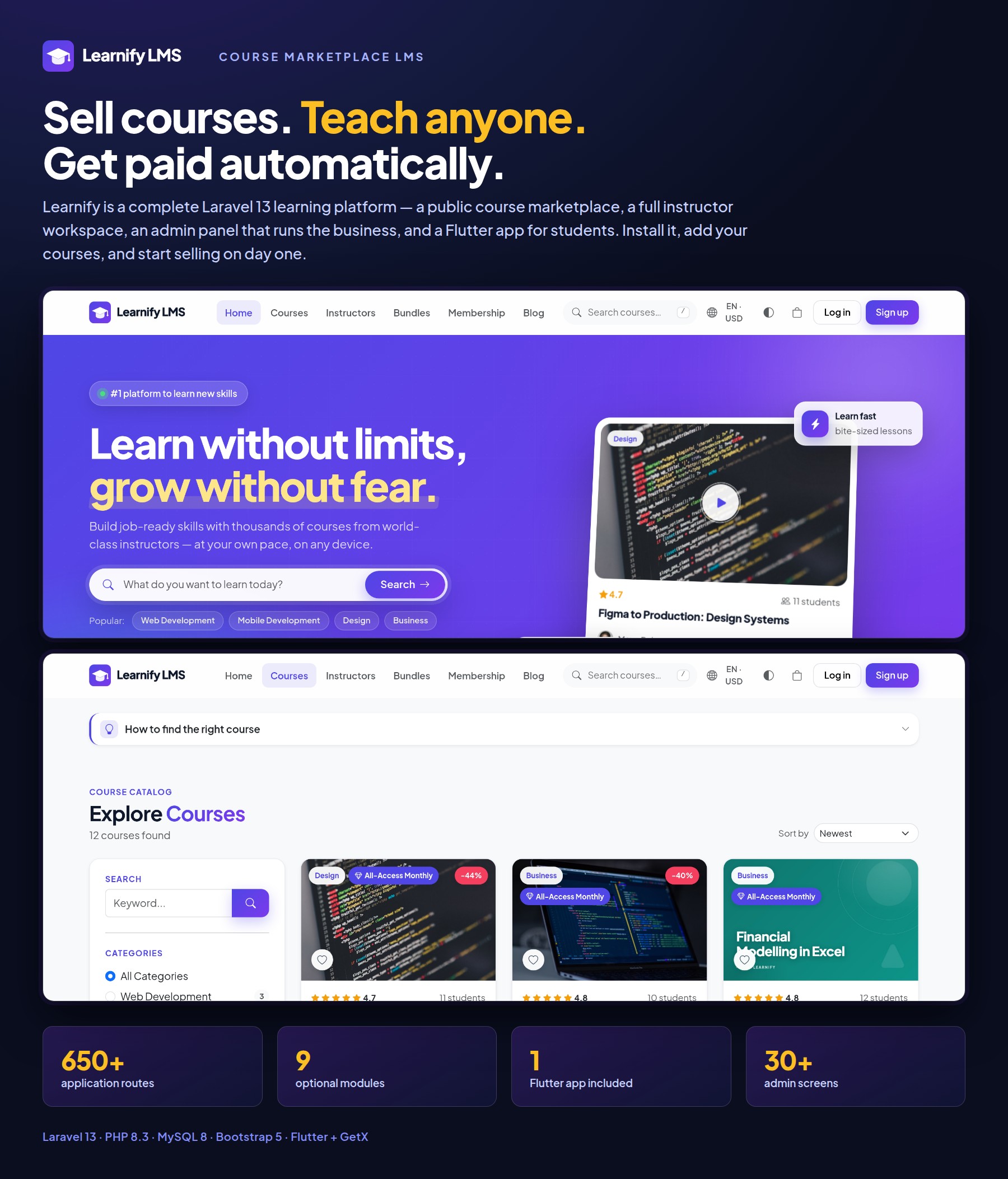
- Course catalogue with keyword search, category, level, price, instructor and minimum-rating filters, and sorting
- Course page with curriculum, the course’s quizzes (question count and exam window), preview lessons, instructor profile, reviews, ratings breakdown, FAQs and an “Ask the instructor” box for questions before buying
- Instructor directory and public instructor profiles with their catalogue and student count
- Cart, wishlist, checkout, coupons, gift a course, a full order history and print-ready invoices for every order; a pending order has a Check payment status button
- Pay in instalments: the first payment enrols, the rest are scheduled with due dates and a grace period
- Waitlist for courses with a seat limit, and a student wallet for refunds, invite bonuses and loyalty points
- Course bundles, membership plans (monthly and yearly, all-access or selected courses) and post-purchase upsell offers
- Learning paths — ordered course sequences with their own landing page
- Test series: sell a set of quizzes on its own, without video lessons — its own
/test-series catalogue and details pages, the same cart, checkout, coupons and gateways as courses, and a Test Series badge in My Learning
- Blog, events, testimonials, FAQs, contact page and static pages, all editable from the panel
- Hero banner with four layouts (classic, centered showcase, full-width photo, bento grid), live learner avatars, rating and popular-topic chips
- Homepage builder: 23 toggleable, reorderable sections — rearrange the storefront without touching a template
- Four website templates — Aurora, Academy, Editorial, Nova — that restyle header, hero, cards, fonts and footer; preview on the live site, apply with one click
- Redesigned checkout: step indicator, one-time order bump, wallet balance and purchase-order options, trust badges and a clear order summary
- Light and dark theme, multi-currency display, and a language switcher
Learning Experience (Web & App)
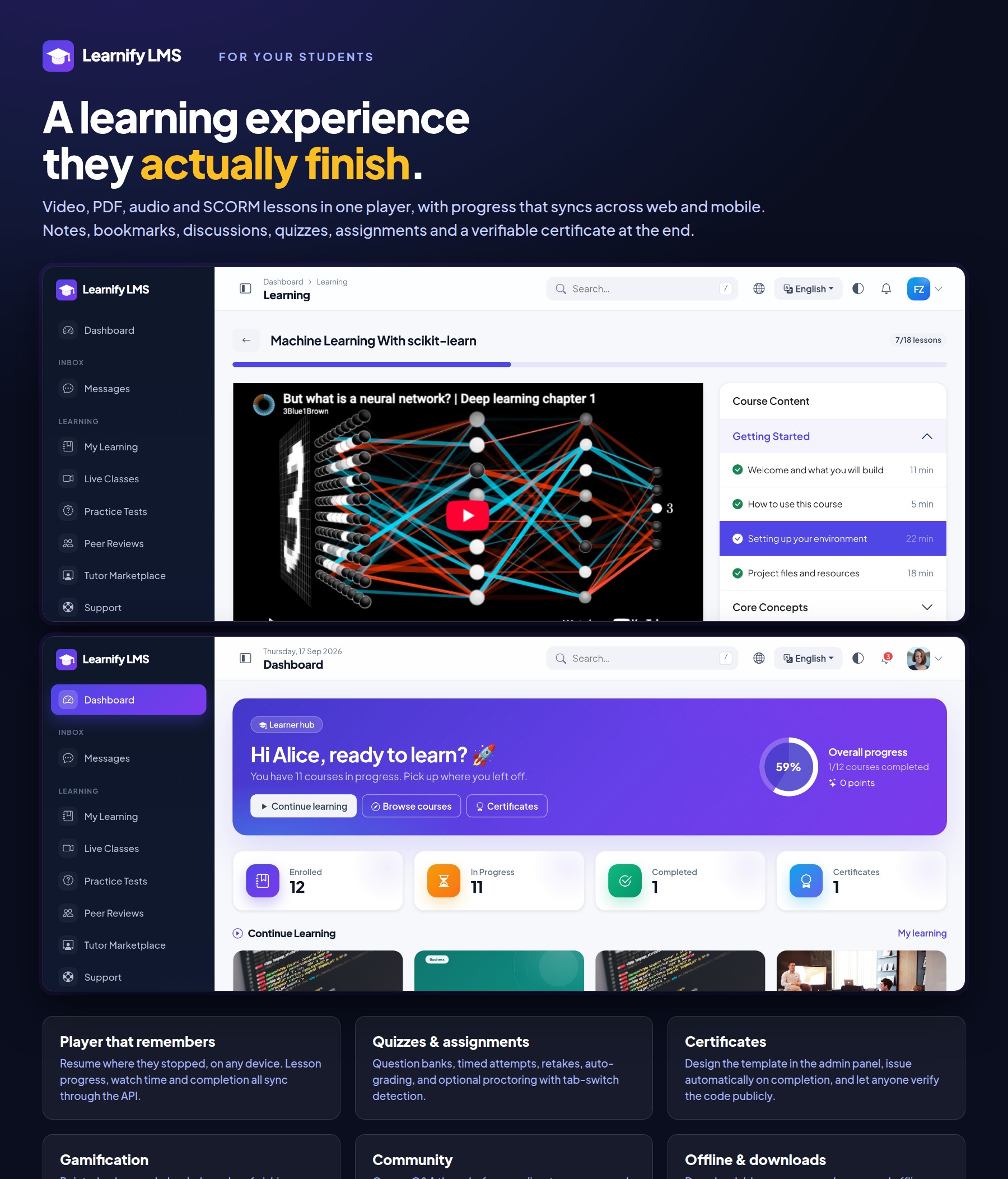
- One player for video, text, PDF, audio, downloadable file, live and SCORM lessons
- Video from YouTube, Vimeo, Google Drive, a direct URL, HLS, an uploaded file, Bunny Stream or Cloudflare Stream, with signed range streaming for uploads; a course preview video (YouTube / Vimeo / Drive / MP4) on the sales page
- Subtitles per lesson, playback resume, Previous / Next navigation with auto-advance on completion, watch time and per-lesson completion, synced between web and app
- SCORM 1.2 and 2004 runtime with tracking, for content authored elsewhere
- Drip content — release sections by schedule or on completion of the previous one
- Per-lesson notes, bookmarks, downloadable resources and a course Q&A thread
- Video checkpoints: the player pauses at a timestamp for a note or a question the instructor placed there
- Practice tests (unlimited, explained answers) and timed mock exams drawn from question banks, with attempt history
- Peer review: classmates score and comment on each other’s assignments anonymously
- Direct messages, course group threads and instructor announcements, with attachments and push notifications
- Support tickets with categories, priorities and staff replies; a tutor marketplace where students post requests, instructors bid, the accepted bid is paid through checkout and the tutor is paid via Earnings
- Quizzes with question banks and eight question types — single-answer and multiple-answer choice, true/false, fill-in-the-blank, put-in-order, match-the-pairs, short answer and essay — plus CSV bulk import, time limits, negative marking, retake rules and instant results with per-question review
- Live exams: set a Publish results at time and learners see only “Answers submitted” until then; at that time every participant gets their score and rank by in-app notification, e-mail and push
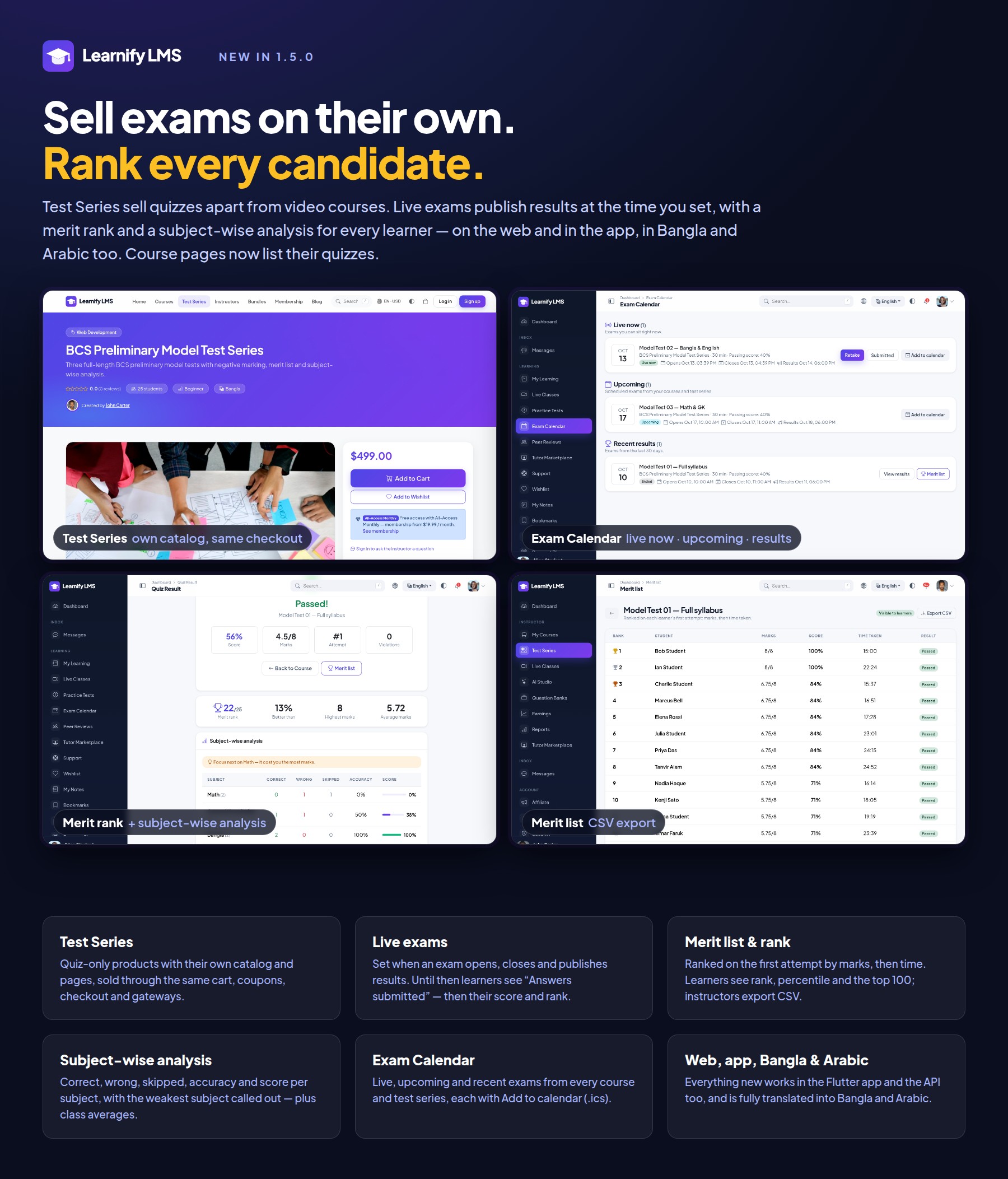
- Merit list and rank: rank on the first attempt (marks, then time taken), percentile, highest and average marks and the top 100 — switched on per quiz
- Subject-wise analysis: correct, wrong, skipped, accuracy and score per subject with the weakest subject called out, per test and across a whole test series
- Exam Calendar: live, upcoming, waiting-for-results and recent exams in one place, with “Add to calendar” (.ics)
- Optional proctoring: full-screen requirement, tab-switch detection, copy-paste blocking, webcam snapshots and a violation log
- Assignments with text, file or link submission, instructor grading with feedback, return-for-resubmission with attempt history, and an optional AI grading assistant
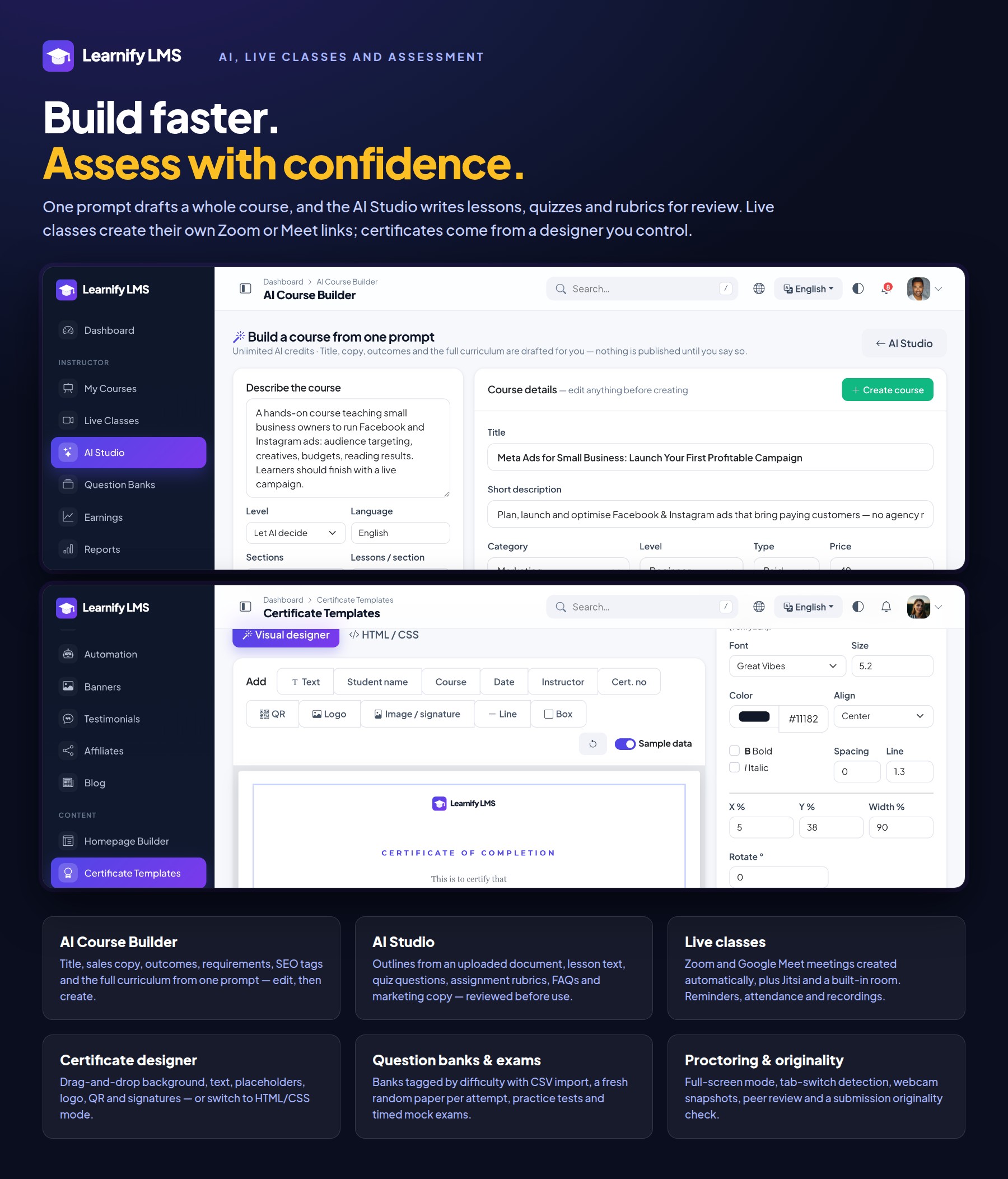
- Certificates issued automatically on completion (with an emailed download link), from a template you design in the drag-and-drop designer, with public verification by code and QR
- Gamification: points, badges and a leaderboard
- Live classes over Zoom (meetings created automatically via the Zoom API), Google Meet (created in the instructor’s calendar), Jitsi or the built-in classroom, with email / push reminders before start, attendance and recordings
- Forums, direct messages and notifications, in the browser and as push
Instructor Workspace
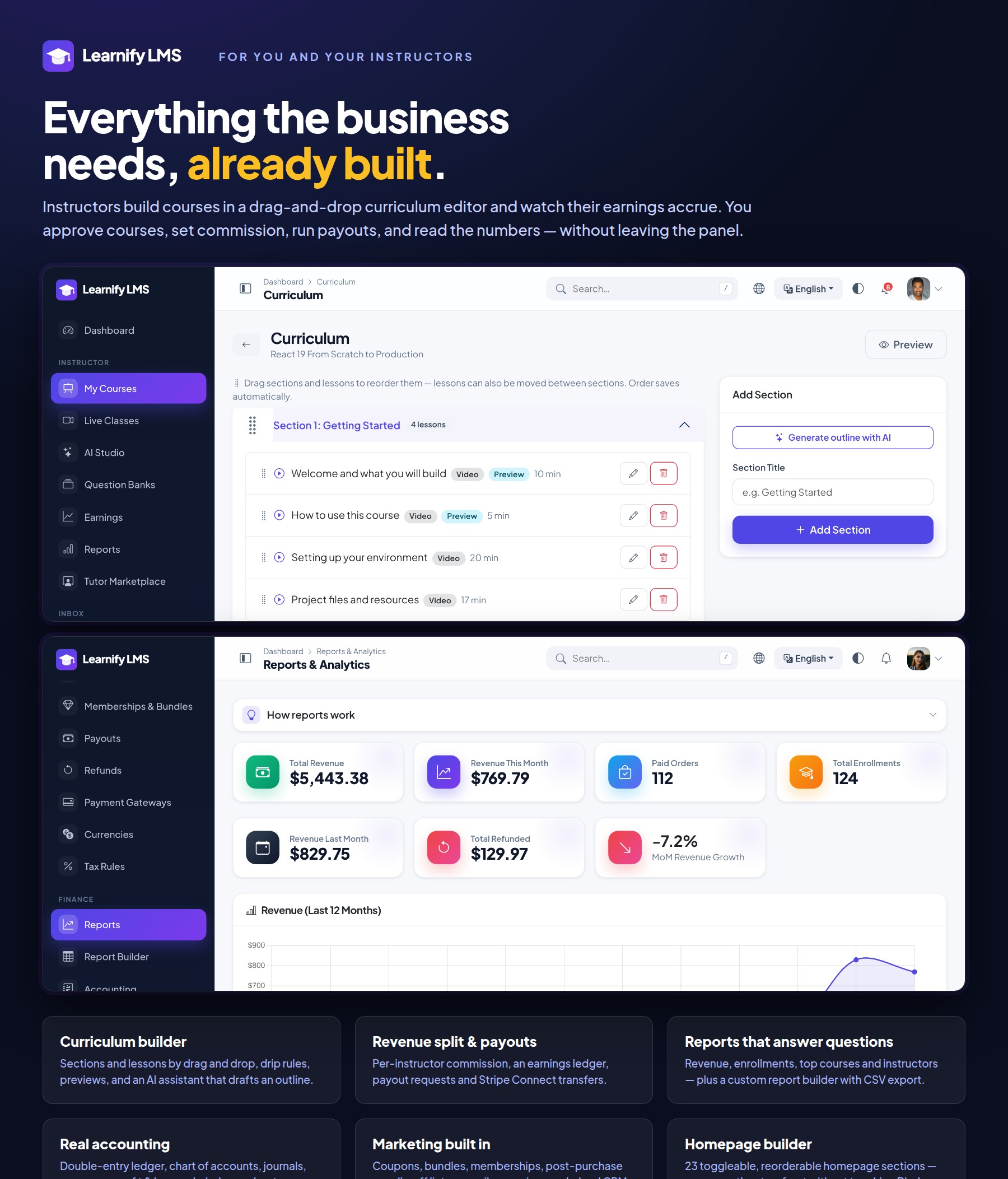
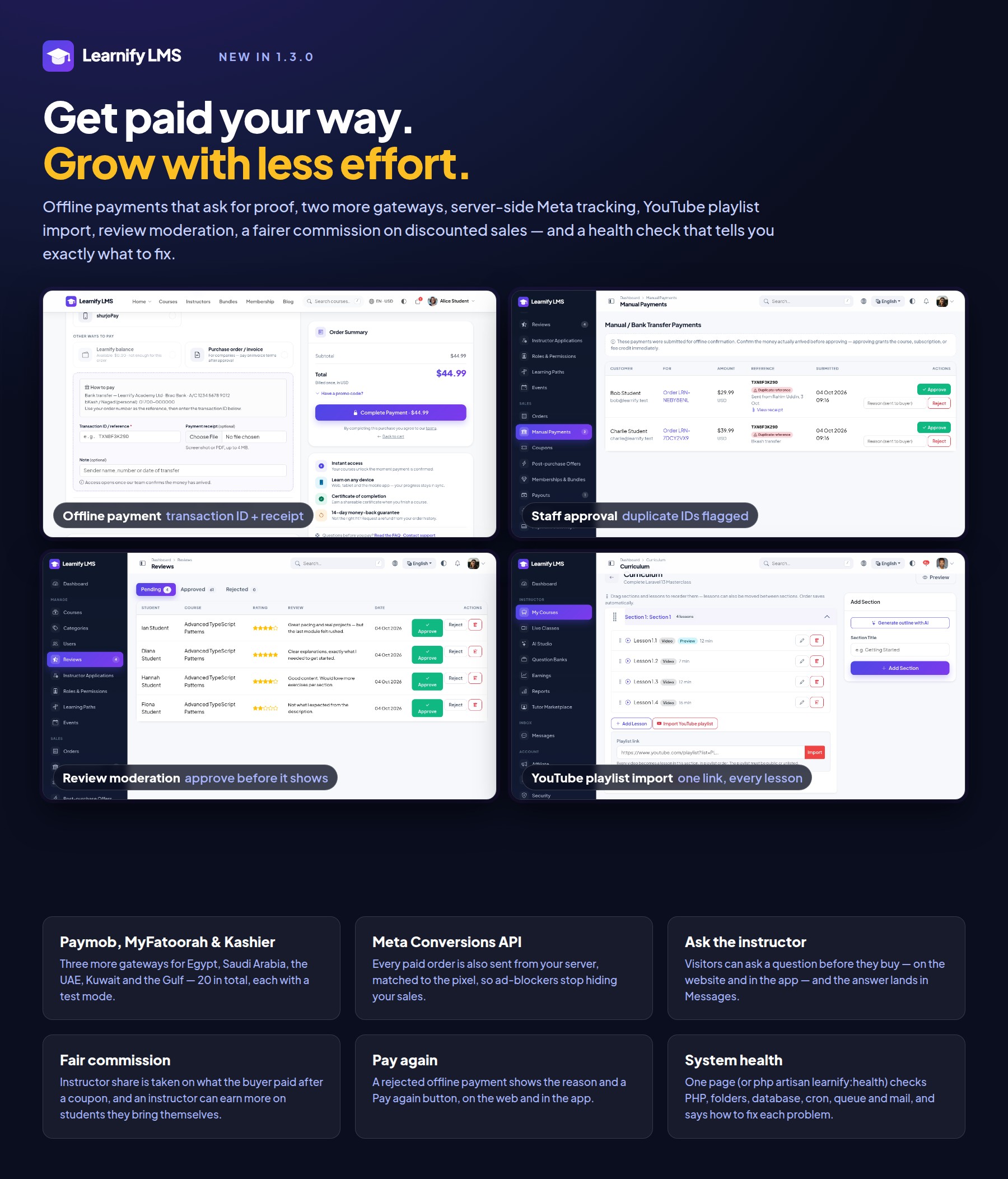
- Drag-and-drop curriculum builder for sections and lessons, with preview flags and drip rules, and one-link import of a whole YouTube playlist as lessons
- AI Course Builder: one prompt drafts the title, sales copy, outcomes, requirements, SEO tags and the full curriculum — edit, then create the course
- Quiz builder with reusable question banks, and attempt review including proctoring snapshots
- Test series builder (quizzes only), result publish time for live exams, a Merit rank column, the full merit list with CSV export, and class performance by subject on the attempts page
- Question banks tagged by difficulty and subject, CSV import, and a fresh random paper per attempt
- Originality check that compares a submission against every other one for the assignment, plus an optional external similarity provider
- AI Studio: course outline (also from an uploaded document), lesson text, quiz questions, an assignment with rubric, course FAQs and marketing copy (titles, descriptions, SEO, email and social) — everything reviewed before it is applied
- Assignment creation with accepted submission types, submission list, grading and return-for-resubmission
- Course FAQs, Q&A answering and review responses
- Live class scheduling with automatic Zoom / Google Meet meeting creation and student reminders
- Earnings ledger, payout requests and Stripe Connect onboarding
- Reports: enrolments, revenue, completion rate and student progress per course
Admin Back Office
- Dashboard with revenue, enrolments, growth and an action list of what needs approving
- Course approval queue (filter by type: course or test series), categories, levels, featured courses, and manual enrolment by e-mail with expiry, revoke and restore
- Instructor applications: approve or reject who may teach (with the applicant’s note and your reason on rejection), the role granted on approval and the decision emailed; or switch marketplace mode off for a single-academy site where only admins add instructors
- Automation rules: abandoned-cart, inactive-learner, course-completion follow-up and membership-expiring emails, each with its own timing and a manual run button
- Users, roles and granular permissions
- Orders, refunds, coupons, bundles, memberships and upsells
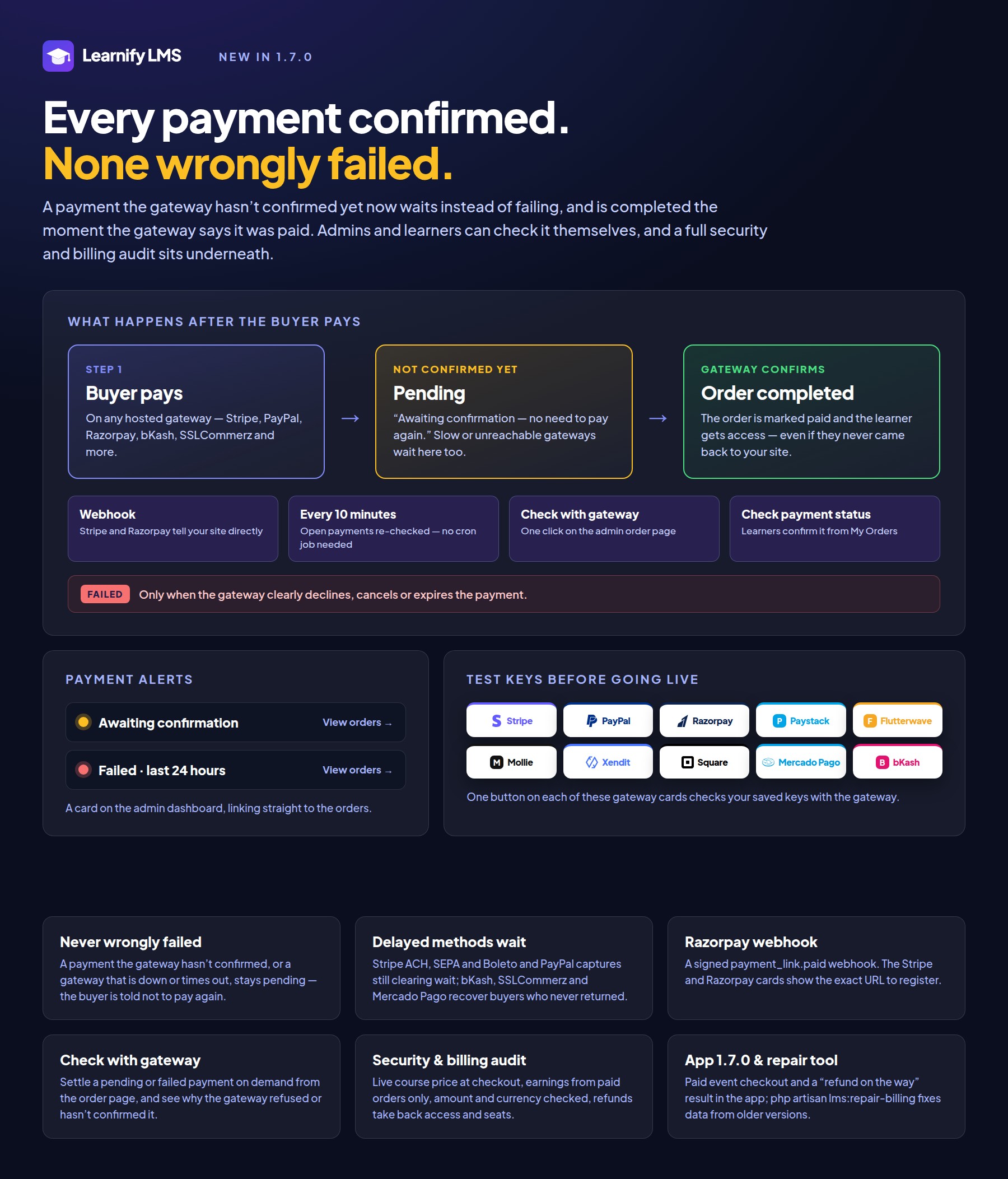
- Payment confirmation you can trust: a payment the gateway has not confirmed yet stays pending (“awaiting confirmation — no need to pay again”) instead of failing, a background check every 10 minutes completes it once the gateway confirms, Check with gateway on the order page settles it on demand and shows why a gateway refused, and a Payment alerts card on the dashboard lists payments awaiting confirmation and failures in the last 24 hours
- Manual / bank-transfer payments held as pending until staff confirm them — the buyer enters a transaction ID and can attach a receipt, staff see duplicate IDs flagged, and a rejection carries a reason and a Pay again button — for orders, memberships and fee invoices alike
- Review moderation: hold new course reviews until an admin approves them; only approved reviews count towards ratings
- System health checklist (also
php artisan learnify:health): PHP, folders, database, cron, queue, mail, backups and gateways, each with a fix
- Support ticket desk and a contact-message inbox
- Revenue share per course, per instructor or global, earnings ledger, payout requests with clear balance messages (decisions emailed) and Stripe Connect transfers
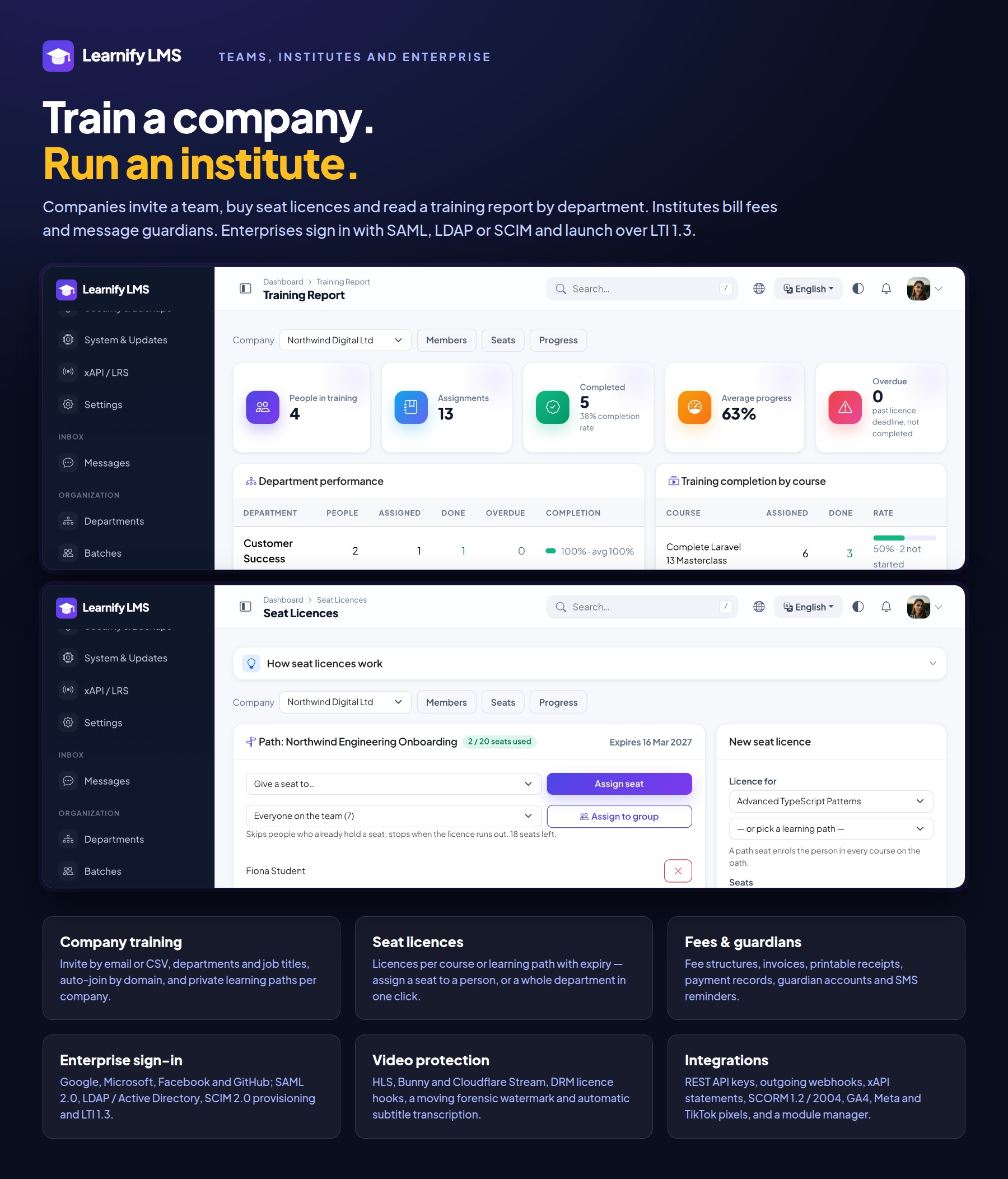
- B2B invoicing: purchase-order number and billing company on orders; company seat licences with allowed e-mail domains for automatic joining, departments, job titles and learning paths pushed per department
- 21 payment gateways grouped by region (Stripe, PayPal, Square, Mollie, Paystack, Flutterwave, Razorpay, Cashfree, Xendit, Mercado Pago, PayTabs, Paymob, MyFatoorah, Kashier, SSLCommerz, EPS, bKash, Nagad, aamarPay, shurjoPay, manual transfer) with sandbox mode, processing fees, API refunds and a Test keys button on the major gateways; currencies with exchange rates; tax rules by country
- Reports and analytics, plus a custom report builder with CSV export and saved reports
- Marketing: promotional banners, email campaigns, testimonials, a lead CRM and an affiliate programme, Meta Conversions API (server-side purchase tracking) alongside the GA4, Meta and TikTok pixels
- Drag-and-drop certificate designer: background, text, placeholders, logo, QR, signature images, fonts and colours, with an HTML/CSS mode for developers
- Transactional email for every step — receipts, enrolment welcome, certificates, assignment updates, live-class reminders, payouts, refunds, applications — with editable templates for email and push, and a push composer
- Appearance settings: website template, colour presets or custom primary / secondary colours, gradients, corner radius, font, default light / dark mode and sidebar style — applied to the storefront and the admin panel together, with a live preview
- Languages, translation manager and RTL support
- SEO settings, sitemap and meta control per course and page
- Mail and storage configuration (local, S3 or compatible), with a storage limit per account
- Security: two-factor authentication with QR and backup codes, login history, an audit trail, GDPR data export and delete, and scheduled backups
- Sign-in with Google, Microsoft, Facebook or GitHub; SAML 2.0 (Entra ID, Okta, ADFS, Keycloak); LDAP / Active Directory; SCIM 2.0 provisioning; LTI 1.3 launches from Moodle, Canvas or Blackboard
- DRM (Widevine / FairPlay) licence hooks, viewer-bound video links with a moving forensic watermark, and automatic subtitle transcription (Whisper, Deepgram, AssemblyAI)
- Order bump at checkout, Google Analytics 4, Meta and TikTok pixels, plus custom head / CSS / body code fields for any other tag or widget
- Module manager — enable or disable optional features without touching code
- Mobile app settings — name, colours, logo and splash for the Flutter app, applied at runtime
- API keys, outgoing webhooks and an xAPI (Tin Can) statement endpoint
- System page with requirement checks, one-click update, cache tools and one-click demo data (five niche presets: academy, school, coaching, corporate, marketplace)
- Demo mode for your own showcase site: destructive actions blocked, hourly automatic reset
Accounting & Finance
- Double-entry ledger with a chart of accounts, posted automatically from orders, refunds and payouts
- Journal entries, opening balances, fiscal periods and reconciliation
- Expenses and expense categories
- Reports: profit and loss, balance sheet, cash flow, trial balance, general ledger, account statements and instructor payables
Institute Features (optional modules)
- Fees: fee structures, invoices, printable receipts, payment records, guardians and fee SMS reminders
- Companies: invite a team by email or CSV, departments and job titles, auto-join by email domain, seat licences per course or learning path with expiry, assign a licence to a whole department or team in one click, company-private learning paths, and a training report with department performance, completion by course, employee progress and CSV export
- Coaching centres and schools: departments, batches with CSV enrolment, an attendance register, guardian portal and SMS alerts (absent, invoice, payment)
- Events with registrations, paid or free, online or on site
- Automation rules for repetitive admin work
Mobile App (Flutter) — students and instructors
- Onboarding, email login, social login and guest browsing
- Home, explore with filters, search, course page with curriculum, reviews and instructor, and Ask the instructor before you buy
- Cart, checkout and payment, returning to the app by deep link when the gateway finishes
- Lesson player with progress sync, notes, bookmarks and offline downloads
- Quizzes, assignments, certificates, badges and the leaderboard
- Test series with a Tests tab and a Type filter in Explore; result screen with merit rank and subject breakdown, a Merit list screen and an Exam Calendar
- Live classes, forums, messages and push notifications
- Instructor dashboard: earnings, pending payout, course status, recent enrolments, reviews, and assignment grading with AI-suggested marks
- White-label: the app takes its name, colours and splash from your admin panel at runtime, with its own app logo (separate from the website logo) uploaded under Mobile App settings
- Light and dark theme, multi-language with RTL
Technologies Used
- Laravel 13 (PHP 8.3) with a modular architecture — no ionCube, no encoded files
- MySQL 8
- Bootstrap 5, jQuery and Blade templates
- Flutter 3.44 with GetX for state, routing and dependency injection
- Laravel Sanctum for API authentication
- Firebase Cloud Messaging for push notifications
- Chart.js for the dashboards and reports
System Requirements
Laravel Backend Requirements
- PHP 8.3 or newer
- MySQL 8.0 or newer (MariaDB 10.6+ also works)
- Apache or Nginx with URL rewriting enabled
allow_url_fopen enabled- A writable
storage and bootstrap/cache directory
- Cron access for scheduled tasks (drip release, campaigns, backups, exam results)
Required PHP Extensions
- BCMath, Ctype, cURL, DOM, Fileinfo, GD (or Imagick), JSON, Mbstring, OpenSSL, PCRE, PDO, PDO MySQL, Tokenizer, XML, Zip
App Requirements (Flutter)
- Flutter 3.44 (stable channel) with Dart 3.12
- Android Studio for Android builds; Xcode on macOS for iOS builds
- Android 6.0 (API 23) and above; iOS 13 and above
- A Firebase project if you want push notifications
- An Apple Developer and/or Google Play Console account to publish
Changelog
Version 1.9.0
- New badges for every role: tests passed, assignments passed, days active and login streaks, forum replies, and for instructors courses published, ratings and course sales. One-click milestone sets (Bronze → Legend, 2 … 256) and progress bars on My Achievements
- bKash & Nagad payouts for instructors, with the TrxID recorded and shown to them, payout methods you can switch on or off, and a minimum payout
- New Find a Tutor directory: search by subject, area, online / in person and price, tutor profiles, booking from the profile and a homepage section
- New Digital Store / Library: sell ebooks, printed books (shipping, stock, tracking), templates and design assets; buyers download from My Library
- My Test Series page for learners, a Test Series admin menu entry and a homepage section
- New Header Menu builder: reorder, rename, hide pages and add your own links
- Redesigned Test Series catalogue with filters and test / question / time details
- Curriculum lesson counts align in a neat column; the header moves extra links under More on laptops; footer shows your gateways’ logos
- Mobile app 1.9.0: achievements, earnings & bKash payouts, Find a Tutor, Store, My Library, Test series tab
Version 1.8.0
- New WhatsApp notifications through the official WhatsApp Business Cloud API: enrolment, payment, live-class reminder, certificate, exam result and graded assignment messages, each with its own switch, test message and delivery log. Learners can opt out
- New weekly progress reports by email, in-app and push: learners get their progress and next lesson, guardians get each child’s week, instructors see who is falling behind
- Payments are never shown as failed while the gateway is still confirming: automatic re-check every 10 minutes, Check with gateway and Check payment status buttons, Payment alerts on the dashboard, Test keys on 10 gateway cards and a Razorpay webhook
- New membership auto-renewal: Stripe subscriptions, automatic renewal from the learner’s balance, or a ready-to-pay renewal reminder for local gateways such as bKash and SSLCommerz
- Add to LinkedIn profile button on certificates
- New Co-instructors: several instructors per course, each with their own revenue share (split automatically on every sale and in payouts) and an optional Can edit right. Course pages and cards show the whole teaching team
- New Progress Tracking for admins and instructors: not started / in progress / completed counts, average progress, filters by course, instructor, status and date, per-learner lessons, quizzes and assignments, CSV export and a Recalculate button. Also in the mobile app for instructors
- New Import students from CSV: preview every row before saving, enrol in courses, new students get a “set your password” email
- Roles & permissions now work on every admin screen: Accountant, Support and your own roles open exactly the screens you tick, and the menu shows only those. Admins keep full access after the update
- Checkout balance: rename it, switch it off or hide it when the balance is too low; the Purchase order / invoice option can be switched off
- Fixed: lesson count and length missing on course cards; draft lessons keeping learners below 100 % (no certificate); social-login users missing from counts (homepage now matches the backend); invented 4.8 rating on new sites; saving settings switching off some options; creating users with custom roles; saving non-YouTube/Vimeo lesson videos
- Mobile app 1.8.0: Student Progress for instructors, teaching team on course pages, co-instructor badge, checkout balance follows the new settings
- Upgrading: copy the new files, then run
php artisan learnify:upgrade or Apply update. Admins keep full access; review your Accountant, Support and custom roles under Roles & Permissions, then press Recalculate once on Progress Tracking. Stripe users: add invoice.paid, invoice.payment_failed and customer.subscription.deleted to the Stripe webhook; Razorpay users: add the webhook shown on the gateway card
Version 1.7.0
- Payments and security release — updating is strongly recommended
- A paid order is never shown as failed: unconfirmed payments stay pending and complete automatically once the gateway confirms (checked every 10 minutes, no cron needed)
- New Check with gateway (admin order page) and Check payment status (My Orders) buttons
- New Payment alerts card on the admin dashboard
- New Test keys button on 10 gateway cards — check your keys before going live
- Razorpay webhook support; Stripe bank debits, PayPal and bKash payments no longer fail while they clear
- Billing fixes: live prices at checkout, earnings from paid orders only, instalments, refunds that take back access, safer payouts
- Paid content access tightened on web and app; paid events sold through checkout
- Mobile app 1.7.0 and small UI fixes
- Upgrading: copy the new files, then run
php artisan learnify:upgrade or Apply update. Razorpay users: add the webhook shown on the gateway card
Version 1.6.0
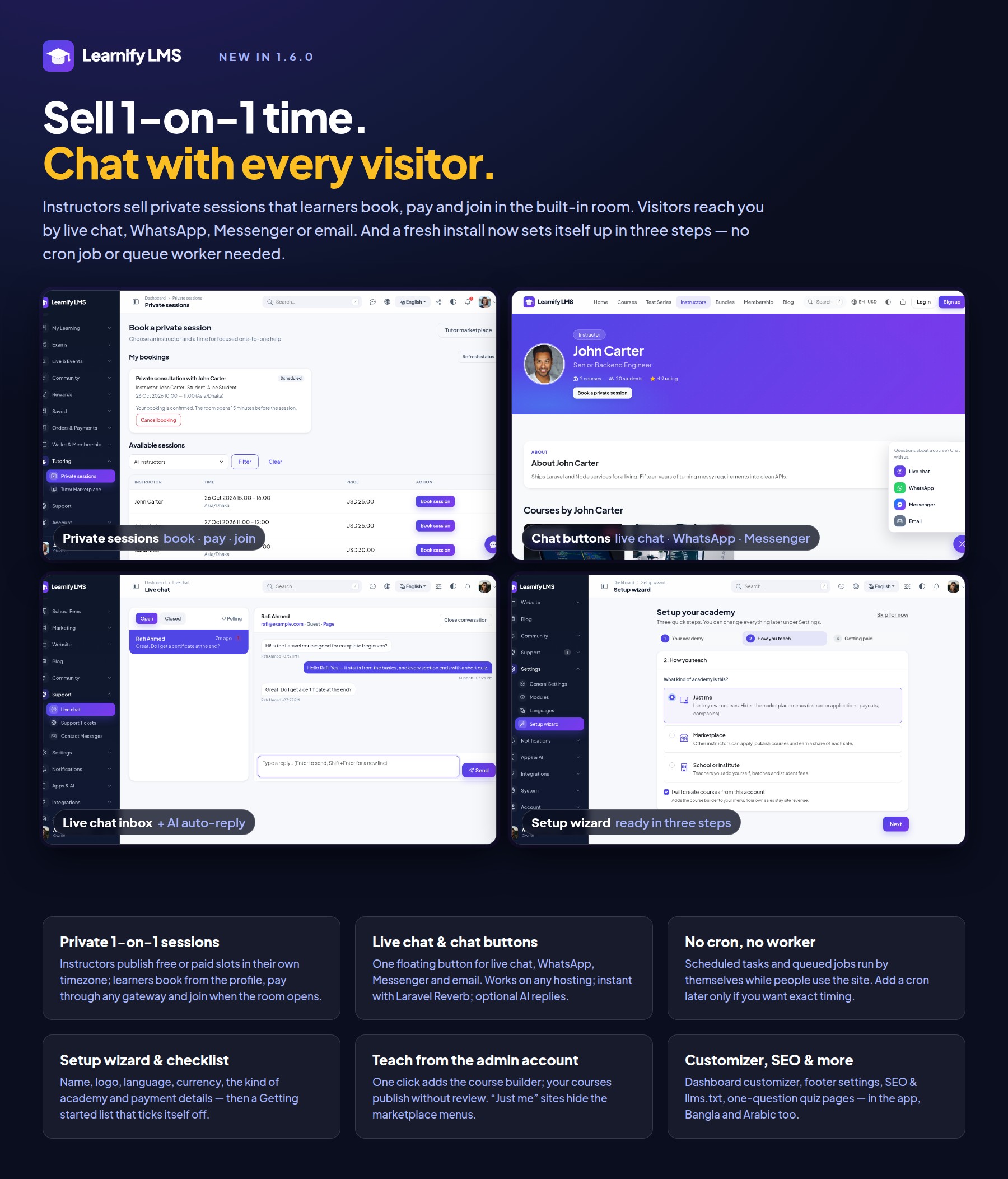
- Private 1-on-1 sessions: instructors publish paid or free time slots in their own timezone (up to eight hours, in the built-in classroom or on their own meeting link; overlaps with other slots and live classes are blocked). Learners book from the instructor’s profile (Book a private session) or Private sessions, pay through the normal checkout and gateways, and join the private room when it opens. Cancelling before the start sends paid bookings to refund review, and the instructor marks the session completed. Also in the mobile app (Profile → Private sessions) and the REST API (
/api/v1/bookings)
- No cron job or queue worker needed: scheduled tasks (live-exam results, email campaigns, expiries, backups) and queued jobs now run by themselves while people use the site — a task whose time passed while nobody was visiting runs on the next visit. Adding a server cron (or having your host open a secret cron address every minute) still gives exact timing and takes over automatically; System Health shows which one is running
- Setup wizard after installing: academy name, logo, language and currency; the kind of academy — Just me, Marketplace (with your commission) or School; and your bank / mobile-wallet details for checkout. Skippable, and you can run it again from Settings → Setup wizard
- Getting started checklist on the admin dashboard — site name and logo, a payment method, email, your first course and background tasks — that ticks itself off as you go and disappears when everything is done
- Teach from the admin account: one click (or a tick in the setup wizard) adds the course builder to your own menu; your courses publish straight away without a review step and their sales stay site revenue. A “Just me” site also hides the marketplace menus it does not need (instructor applications, payouts, companies)
- Edit what you wrote instead of deleting and re-adding it: question-bank and quiz questions (past attempts keep their answers), course FAQs, video checkpoints, notes, forum topics and replies (until the topic is closed), course Q&A questions and answers, and company departments — each limited to its author, or an admin / the company manager where that applies
- Quizzes show one question per page: progress bar, numbered navigator with answered questions marked, Previous / Next, and a warning about unanswered questions before submitting. The timer, auto-submit and proctoring work as before, and every question stays on one page if JavaScript is off
- Course review workflow: instructors send a draft or rejected course to the admin with Submit for review / Resubmit for review; it stays unpublished until approved
- Translations: one shared catalogue for the website and mobile-app strings. Admin → Translations imports and exports JSON or CSV with a preview of every change, “merge” or “fill missing only” modes and a sample template to translate offline; translation editing also works on demo sites. API:
GET /api/v1/translations/{code}
- Lesson player: playback speed and captions on YouTube lessons, resume where you left off on YouTube, uploaded and HLS videos (the position is saved on pause and when you leave), a “Try again” message when playback is interrupted, and keyboard controls (Space, ← / → to skip 10 seconds)
- Mobile app catches up with the website: it loads your own translations from the server (edits and imports under Admin → Translations reach the app, and a language you add later works without a new app build); videos resume where the learner stopped on any device and count watch time, so lessons with a minimum-watch rule can be completed in the app; learners edit their notes, course Q&A and forum posts; instructors send a draft or rejected course for review
- Live classes and private sessions in the built-in classroom open inside the mobile app with camera and microphone (join / leave attendance included); Zoom, Google Meet and custom meeting links still open in their own app. Meeting links up to 2,048 characters are accepted. On the free public meet.jit.si server the instructor must log in to start a meeting — add your own Jitsi server or 8×8 JaaS keys under Settings → Live classroom so instructors start without a login
- SEO & AI search: new Settings → SEO tab with a default meta description, a default share image for Facebook / WhatsApp / LinkedIn / X, a “hide this site from search engines” switch for staging and demo sites, extra robots.txt rules and an llms.txt introduction.
robots.txt and llms.txt are now generated automatically with your own domain and catalogue; the sitemap adds learning paths, bundles and events and leaves out login-only forum pages; instructor profiles and the FAQ page get structured data; dashboard and login pages are kept out of search results
- Marketing pixels: Add to Cart now fires for courses, bundles and memberships (Meta Pixel, GA4 and TikTok), and View Content, Add to Cart and Initiate Checkout share the same product IDs for catalogue ads and retargeting
- Dashboard: the sidebar is grouped into collapsible sections; only the section for the open page starts expanded and opening one closes the others (choose “Flat list” under Settings → Appearance for the classic menu); the collapsed sidebar shows your favicon instead of a cropped logo and the name of each icon on hover; a Messages icon in the top bar shows unread messages
- Live chat: visitors (guests or signed-in learners) chat with your team from a floating button on the website; you answer in Admin → Live chat with unread counts and open / closed conversations. It works on any hosting by checking for new messages every few seconds, and becomes instant when you run Laravel Reverb (add the
REVERB_* keys to .env, run php artisan reverb:start, then switch on realtime under Settings → Chat buttons)
- Chat buttons: the same floating button can also open WhatsApp (with a pre-filled message), Facebook Messenger and email — live chat and each link have their own on / off switch under Settings → Chat buttons, so you can hide one without losing its number. Plain links to the visitor’s own apps, so no third-party script is loaded. All of them are switched on in the demo
- Dashboard customizer (sliders icon in the top bar): light / dark, brand colour, sidebar style, corners, font and a compact density preview instantly and are kept per browser; admins can Save for everyone to make it the site-wide look. Limit it to admins and instructors under Settings → Panel
- Phones and right-to-left: no more sideways scrolling on 360 px screens (public header, login / register, home categories in Arabic); dashboard stat tiles sit two per row; long titles shorten inside their cards; the review form, lesson player controls, learning-path track and instructor application fit small screens; dashboard tables (orders, reports and more) swipe sideways instead of cutting off columns; and on Explore courses the filters open from a Filters button as a bottom sheet, so the courses show first
- Website footer, all from Settings and hidden while empty: social icons now link to your profiles (Facebook, X, Instagram, LinkedIn, YouTube, TikTok); Google Play / App Store download buttons; WhatsApp, address and office hours under Get in touch; a “We accept” row listing the payment gateways you have switched on; and one link column of your own (new Settings → Footer tab)
- Companies (B2B): staff now create and edit companies from Organization → Companies — name, type, contact details and an optional owner who then manages that company’s members, departments, seats and progress. Company Teams and Seat Licences used to answer 404 until a company existed, and there was no way to add one. The demo includes a sample company with departments, members (joined and invited) and a seat licence
- Demo content: every demo lesson now uses an on-topic video that can be embedded (the old demo video was blocked from embedding by its owner); existing installs are updated automatically when you apply the update
- Fixed: YouTube lessons could only be started in fullscreen (and on phones); a lesson whose YouTube video was removed or blocked from embedding now says so instead of “check your connection”; duplicate “From name” field and missing menu icon on Mail & Storage; unlabelled marks fields in the question-bank form; misaligned file and import-mode fields on Translations
- Everything new is translated into Bangla and Arabic, on the web and in the app
Version 1.5.0
- Test series as a separate product: instructors build them from Instructor → Test Series (quizzes only, no video lessons); they get their own
/test-series catalogue and details pages, go through the normal cart, checkout, coupons and 21 gateways, and show a Test Series badge in My Learning; the admin course list filters by type, and the app’s Explore has a Type filter
- Passing every active quiz in a test series moves progress, completes it and issues the certificate
- Course details pages list the course’s active quizzes (question count and exam window) under the lessons; buyers get “Take quiz”, visitors see a lock
- Live exams: a quiz can have a Publish results at time. Until then learners and parents see only “Answers submitted” — no score, pass/fail or review — on web, API and app. When the time passes, every participant gets their score and merit rank (in-app, e-mail and push; editable template Exam result published). Needs the cron job to run
php artisan schedule:run every minute
- Merit list: tick “Show merit list and rank to learners” on a quiz. Learners are ranked on their first attempt (marks, then time taken; equal results share a rank) and see their rank, percentile, highest and average marks and the top 100; instructors get a Merit rank column, the full list and a CSV export
- Subject-wise analysis: questions take a Subject (or inherit the question bank’s subject; CSV import column 12
subject). The result page shows correct / wrong / skipped, accuracy and score per subject with the weakest subject called out; test series show it across all tests; instructors see the class performance per subject
- Exam Calendar (Learning → Exam Calendar, and in the app’s Profile menu): live, upcoming, waiting-for-results and recent exams, with “Add to calendar” (.ics)
- Paid tests follow the same access rules as lessons: a refunded, expired or ended enrolment can no longer open or submit the course’s quizzes, and draft quizzes are closed to learners
- Free samples on paid courses are labelled Free sample — no purchase needed, ask for confirmation when ticked and show a Free sample badge in the quiz list
- Mobile app: YouTube and Vimeo lessons play inside the app (no more jumping to the YouTube app, “Error 153” fixed), fullscreen on Android, the screen stays awake during a lesson, and a loading spinner and “Try again” for hosted and uploaded videos
- REST API:
GET /api/v1/courses?type=course|test_series, GET /api/v1/quizzes/{id}/merit and GET /api/v1/exams/calendar; quiz results follow the quiz’s “show results immediately” setting
- Everything new is translated into Bangla and Arabic, on the web and in the app
Version 1.4.0
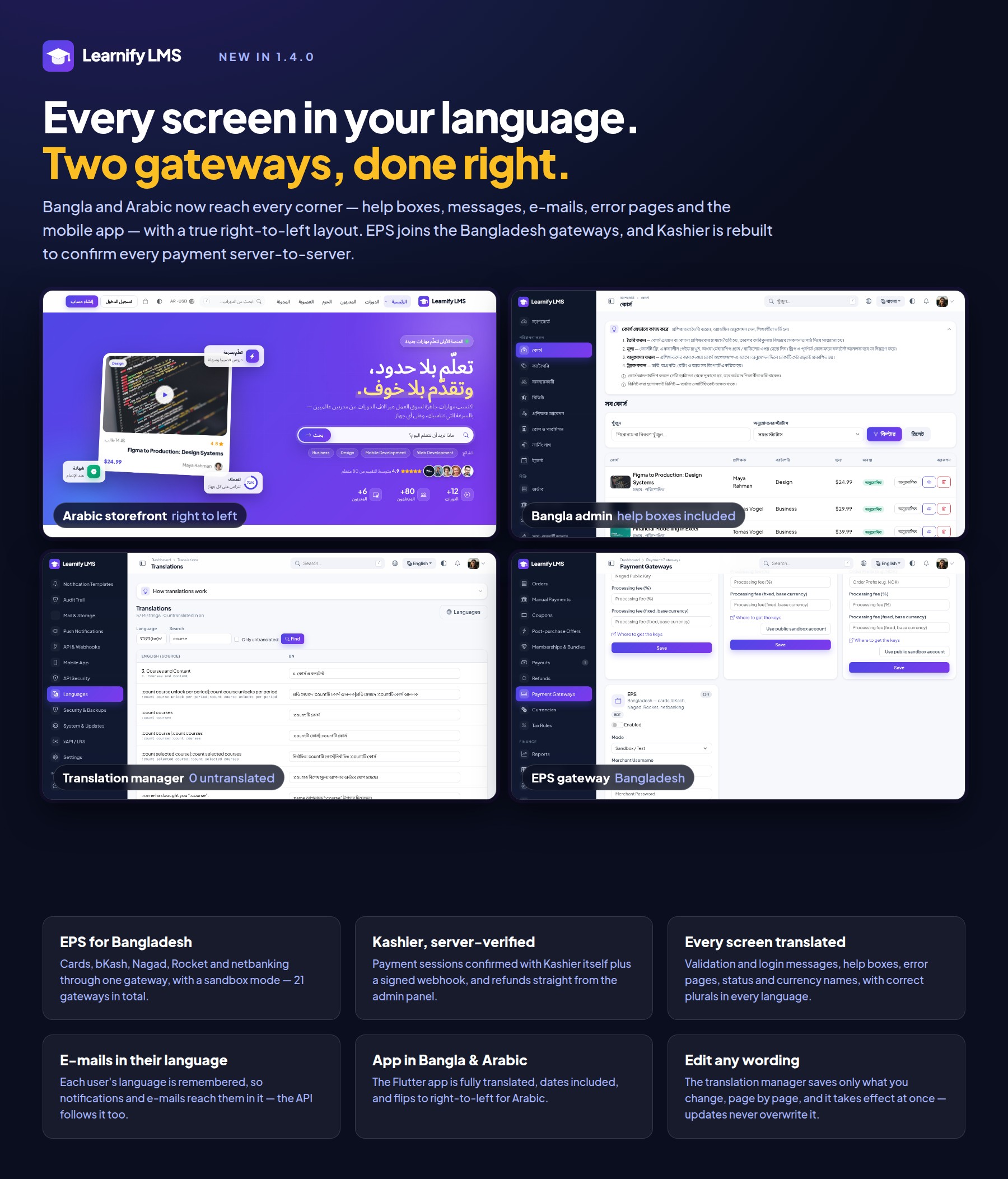
- New EPS gateway for Bangladesh (cards, bKash, Nagad, Rocket, netbanking) — 21 payment gateways in total
- Kashier rebuilt on Kashier’s Payment Sessions API: payments are confirmed server-to-server with a webhook, and refunds work from the admin panel (add your Kashier Secret Key after updating)
- Every screen follows the chosen language: validation and login messages, help boxes, error pages, status and currency names, and correct plurals (including all six Arabic forms)
- E-mails and notifications are sent in each recipient’s own language; the API and the mobile app follow the selected language
- Mobile app fully translated into Bangla and Arabic, with right-to-left layout for Arabic
- Translation manager saves only the strings you change, page by page, and your edits take effect immediately
- Fixed: current lesson highlight in the lesson player; badge overlap on course cards in right-to-left languages
Version 1.3.0
- 13 more payment gateways (20 in total): Square, Mollie, Paystack, Flutterwave, Razorpay, Cashfree, Xendit, Mercado Pago, PayTabs, Paymob, MyFatoorah, Kashier, SSLCommerz, bKash, Nagad, aamarPay and shurjoPay — grouped by region, with coverage, currencies and sandbox credentials shown for each
- Import a whole YouTube playlist as lessons in one click; review moderation (approve reviews before they show); “Ask the instructor” on course pages; an instructor own-referral commission rate; Meta Conversions API (server-side purchase tracking that ad-blockers cannot hide)
- System Health checklist in the admin panel and
php artisan learnify:health — checks PHP, folders, database, cron, queue and mail and says how to fix each problem
- Offline payments (bank transfer, cash, mobile wallet) now collect a transaction ID and an optional or required receipt upload, shown to staff with duplicate-ID warnings and a reject-with-reason email — web and mobile app
- Instructor commission is now calculated on the price actually paid after a coupon (tax excluded), so discounted and free orders no longer overpay instructors
- Redesigned checkout and order page — step indicator, order bump, wallet and purchase-order options, trust badges
- 4 website templates (Aurora, Academy, Editorial, Nova) with an admin preview bar to try one before applying it
- Flash messages and notifications shown as toasts
- Upload a logo just for the mobile app (splash, home header, login) from Admin → Mobile App
- One-tap Student and Instructor demo logins on demo sites only
- Bangla and Arabic translations complete (about 2,700 strings each)
Version 1.2.0
- One-click Automatic Update — upload the release ZIP under Admin → System & Updates and it installs itself: extracts the package, backs up the folders it is about to touch, swaps them in, migrates, reseeds roles/permissions and reference data, and clears caches
- Manual/cPanel update path for hosts that block ZIP uploads, with a one-click Apply update button
- Super-admin quick-sync URL — a super-admin/owner can hit
/admin/system/quick-sync directly after copying files in by hand to migrate and re-sync permissions, no maintenance window
- Every update path now re-syncs the super-admin/owner role to the release’s full permission set automatically
Version 1.0.0
Initial release, with:
- Course marketplace storefront — catalogue, cart, checkout, coupons, bundles, memberships, learning paths, homepage builder and 4 website templates (Aurora, Academy, Editorial, Nova)
- Full learning experience — video/text/PDF/audio/live/SCORM lesson player, quizzes (8 question types), assignments, peer review, proctoring, certificates, gamification and live classes (Zoom, Google Meet, Jitsi)
- Instructor workspace — drag-and-drop curriculum builder, AI Course Builder, AI Studio, question banks, grading and an earnings/payout ledger
- Admin back office — approvals, automation rules, roles & permissions, SSO (Google/Microsoft/Facebook/GitHub, SAML, LDAP, SCIM, LTI 1.3), DRM & video protection, and a module manager
- Accounting & finance — double-entry ledger, journal entries and P&L / balance sheet / cash-flow reports
- Institute features — fees & guardians, company seat licences, batches/attendance, events
- Payment gateways including manual bank transfer (the full list of 20 is under 1.3.0)
- Flutter mobile app for students and instructors, white-labelled at runtime (name, colours, logo, splash) from the admin panel
- No ionCube, no licence server — plain, readable PHP and Dart source throughout